

Redefining the "Edge": From Data Caching to Insightful Decision-Making
In autonomous driving, high-frequency defect detection, and robotic kinematics, processing latency isn't just a throughput issue—it’s a safety and functional showstopper. Deploying high-precision AI models (like YOLOv10 or Vision Transformers) directly at the source is the prerequisite for Physical Artificial Intelligence.
Why General-Purpose AI Servers Fail at the Edge
- Thermal and Power Constraints: Edge nodes are often confined to cramped AGV cabinets or outdoor utility poles, imposing strict limits on Total Dissigned Power (TDP) and form factor.
- Environmental Stress: Unlike climate-controlled data centers, edge hardware must withstand cycles from -25°C to +60°C and handle continuous, high-impulse shock and vibration.
- Hardware Determinism: AI inference outputs must be synchronized with physical control logic (like PLC commands to a servo motor) on the same microsecond timeline, without CPU scheduling jitter.
Yantronic Edge AI: Fusing Extreme Compute with Uncompromising Resilience
We match compute density with environmental endurance through deeply customized Heterogeneous Architectures and Thermal Management.
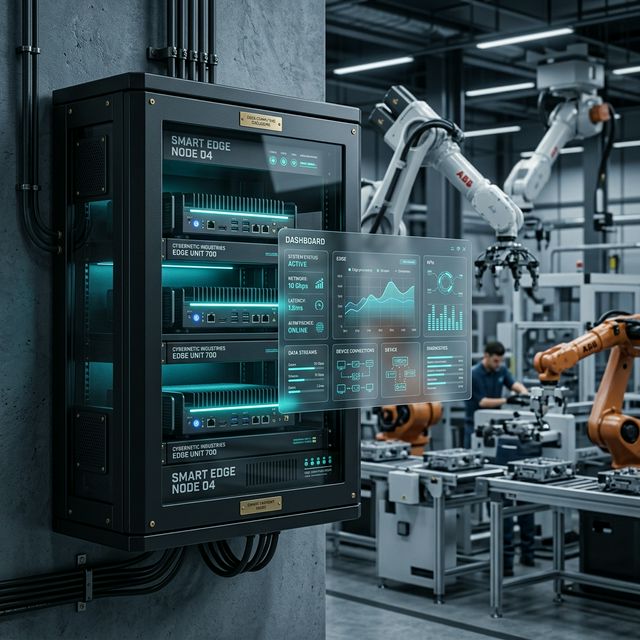
High-Performance Vision Inference Station - YX-AI800
Supports full-size standalone GPUs for city-scale surveillance analytics and medical imaging.
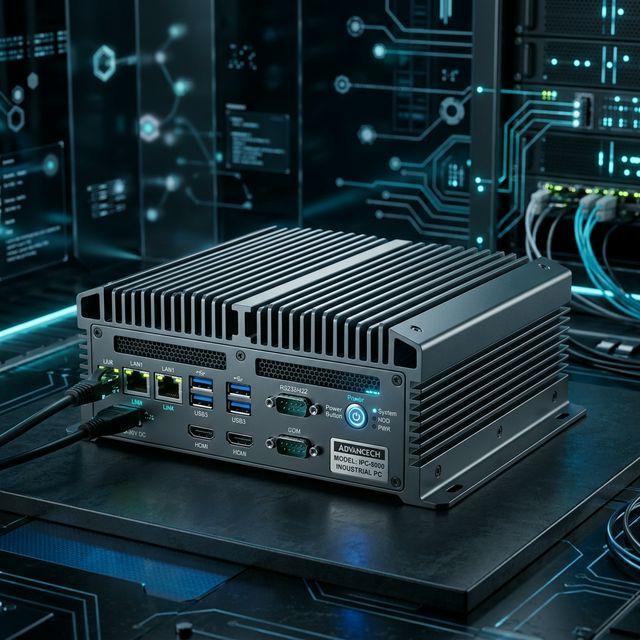
Ultra-Low-Power Edge AI Kit - YX-Nano
Packing heterogeneous compute into the tightest spaces of AGVs and autonomous mobile robots (AMRs).
Edge AI Deployment: The "Compute vs. Environment" Matrix
Choosing your platform requires balancing model complexity against localized physical constraints:
| 暂无对比数据 | ||
Engineering Deep-Dive (Technical FAQ)
From Whiteboard to Field Deployment
The biggest barrier to scaling Edge AI is the transition from a laboratory prototype to a field-ready node that survives the heat and shock of the real world. Yantronic’s senior application engineers are here to guide you through thermal simulation and Proof of Concept (PoC).
Real-World Deployment Examples
Case 1: Inline AI Quality Inspection for High-Speed Production
A manufacturer wanted to detect scratches, missing parts, and label defects directly on a fast-moving production line. The inspection model had to run beside the cameras and trigger reject actions immediately, without sending raw images to the cloud.
- Deployment challenge: the system needed deterministic response, multi-camera input, and continuous operation in a harsh industrial cabinet.
- Practical architecture: an edge AI workstation handled image ingestion, local inference, and PLC output on the same platform, reducing handoff latency between vision and control.
- Why edge AI mattered: inference stayed close to the process, so network jitter did not interfere with pass/fail decisions.
- Business value: the plant improved defect capture at the source, reduced false rejects caused by timing drift, and simplified scaling to additional stations.
Case 2: Remote Visual Analytics for Smart Infrastructure
A city integrator needed to analyze roadside or perimeter video feeds for object detection, queue monitoring, and incident tagging in locations where bandwidth and maintenance access were both limited.
- Deployment challenge: outdoor edge nodes had to tolerate thermal cycling, unstable power, and long service intervals while still handling live video workloads.
- Practical architecture: ruggedized edge servers processed camera streams locally, retained recent footage for short-term review, and pushed only metadata or exception clips to the central platform.
- Why edge AI mattered: most frames never needed to leave the site, which reduced backhaul pressure and improved response time for local actions.
- Business value: operators gained faster situational awareness, lower network cost, and a more practical deployment model for distributed sites.
Case 3: Containerized Model Rollout Across Distributed Facilities
An operations team wanted to standardize one vision-AI stack across warehouses, depots, and production outposts, but needed a manageable way to update models, dependencies, and rollback states.
- Deployment challenge: manually maintaining different AI runtimes on each site created drift, inconsistent outputs, and high support overhead.
- Practical architecture: the AI application was packaged into containers and deployed to edge nodes through a centralized orchestration workflow, with configuration managed by site role.
- Why edge AI mattered: the hardware remained local to the cameras and sensors while software updates could be rolled out in a controlled, repeatable manner.
- Business value: the customer reduced deployment variance, accelerated expansion to new sites, and made field support much more predictable.