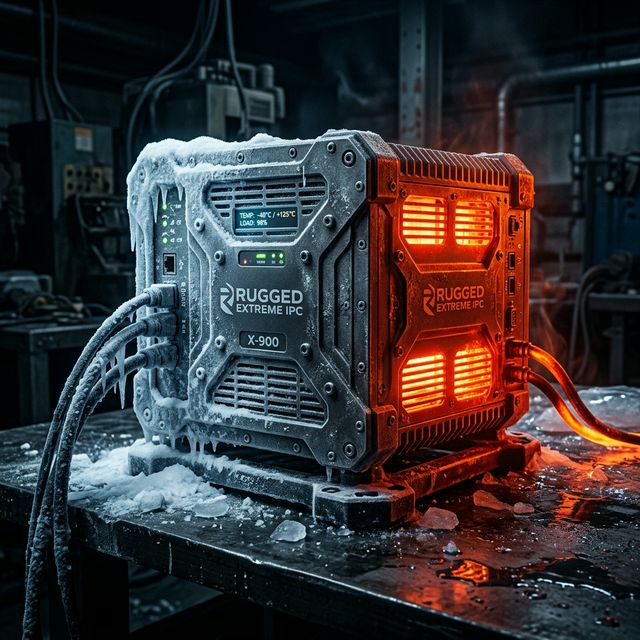
How industrial PCs achieve reliable operation across extreme temperature ranges — from arctic installations to desert deployments and everything in between.
Wide temperature industrial PCs are engineered to operate reliably across extreme ambient conditions — typically -20°C to 60°C (standard) or -40°C to 70°C (extended). This is achieved through industrial-grade components, fanless aluminum heatsinks, conformal coatings, and wide-range DC power inputs. Consumer PCs are only rated for 0°C to 35°C.
| Category | Operating Temp | Storage Temp | Typical Application |
|---|---|---|---|
| Consumer PC | 0°C to 35°C | -20°C to 60°C | Office, home, climate-controlled rooms |
| Standard Industrial PC | -20°C to 60°C | -40°C to 80°C | Factories, warehouses, mild outdoor |
| Extended Temp IPC | -40°C to 70°C | -45°C to 85°C | Arctic, desert, steel mills, military |
| Military/Aerospace | -55°C to 85°C | -65°C to 125°C | Defense, satellite ground stations |
Standard components fail under extreme temperatures. Here is how industrial PCs are engineered differently at the component level.
Consumer SSDs (MLC/TLC NAND) fail below -10°C due to charge trapping. Wide-temp SSDs use SLC or pSLC NAND rated for -40°C to 85°C with enhanced ECC. Always verify the SSD datasheet — not just the IPC spec sheet.
Industrial wide-temp memory uses lead-free BGA packaging, tested to -40°C to 85°C with tighter timing margins for cold-start reliability.
Wide-temp designs use ceramic caps (X7R/C0G) and polymer aluminum capacitors rated for -55°C to 125°C to prevent ESR increases.
Industrial processors (like Intel Atom or ARM RK3588) offer -40°C to 85°C Tj ratings. This is paired with wide-range DC inputs (9–36V) featuring soft-start circuitry preventing inrush current surges during high-stress cold starts.
Temperature management is a dual challenge: dissipating heat at high ambient temperatures while ensuring cold-start capability at sub-zero conditions.
Aluminum-alloy extrusion enclosures with CNC-machined fin arrays provide large surface area for natural convection and radiation. Thermal pads (1–5 W/mK) bridge the gap between CPU die and chassis. This approach eliminates moving parts, achieving MTBF of 100,000+ hours.
At extreme high temperatures, intelligent thermal management reduces CPU frequency (throttling) before reaching Tj max, rather than shutting down. This maintains system availability at reduced performance.
Some extended-temp IPCs include an internal heater module that pre-warms critical components (SSD, DRAM, capacitors) to -20°C before allowing full power-up. This prevents cold-start failures without requiring external heating.
Rapid temperature cycling creates condensation on PCBs. Silicone conformal coating (IPC-CC-830) creates a moisture barrier without impeding heat transfer, preventing short circuits in high-humidity transitions.
Frozen food warehouses (-25°C), refrigerated trucks (-18°C), cold storage facilities. Extended-temp IPCs with IP65 protection manage inventory systems, door control, and temperature monitoring without heating enclosures.
Ambient temperatures reaching 55°C+, with internal enclosure temperatures exceeding 70°C. Solar inverter monitoring, pipeline SCADA, and oil & gas wellhead automation require extended-temp IPCs with proper derating.
Blast furnaces, smelters, and hot rolling mills create localized heat zones exceeding 60°C. Combined with heavy dust, vibration, and electromagnetic interference, these environments demand the most robust wide-temp IPCs.
Railway, fleet management, and in-vehicle computing face temperature cycling from -30°C overnight parking to 60°C+ sun-baked cabins. Add vibration (IEC 61373 for rail) and power transients (vehicle electrical systems).
Common questions about wide temperature computing.
Industrial PCs typically support two temperature ranges: Standard wide temperature (-20°C to 60°C) which covers most factory, warehouse, and mild outdoor environments; and Extended wide temperature (-40°C to 70°C) for extreme deployments like arctic operations, desert installations, steel mills, and military applications. Consumer PCs, by comparison, are only rated for 0°C to 35°C.
Wide temperature IPCs differ in several critical areas: (1) Industrial-grade components rated for extended temps (capacitors, memory, SSD, CPU); (2) Fanless thermal design using aluminum heatsink chassis for passive cooling; (3) Wide-range DC power input (9–36V or 12–48V) tolerant of voltage fluctuations; (4) Conformal coating on PCBs to prevent condensation damage; (5) Extensive environmental testing per IEC 60068 or MIL-STD-810 standards.
Standard consumer SSDs use MLC/TLC NAND flash rated for 0°C to 70°C operating temperature. Below freezing, NAND cell bit error rates increase dramatically due to charge trapping effects, causing data corruption. Memory modules (DRAM) can suffer from timing violations at extreme temperatures as electrical characteristics shift. Wide-temp SSDs use SLC or pSLC NAND flash rated for -40°C to 85°C, with enhanced ECC algorithms and wear-leveling to maintain data integrity.
Yes, fanless industrial PCs are specifically designed for high ambient temperatures. Their aluminum-alloy heatsink enclosures provide large surface areas for passive heat dissipation. Key design factors include: thermal pad compound between CPU and chassis, fin spacing optimized for natural convection, and TDP-appropriate processor selection. A well-designed fanless IPC can dissipate 15–25W TDP passively even at 60°C ambient, making them ideal for enclosed machinery and outdoor installations.
Several international standards verify wide temperature performance: IEC 60068-2-1 (Cold testing — sustained low temp operation and cold start), IEC 60068-2-2 (Dry heat testing — sustained high temp operation), IEC 60068-2-14 (Thermal shock — rapid cycling between temperature extremes), MIL-STD-810H Method 501/502 (Military-grade hot/cold testing), and HALT/HASS (Highly Accelerated Life/Stress Testing for reliability prediction). Always request test reports from manufacturers to verify claims.