Logo
Products
Applications
Guides
About
Support
PhoneContact Us
Products
  • NUC/Nano Motherboard
  • 3.5-inch Motherboard
  • All-in-one IPC
  • Scalable Embedded Series
  • Mini Size series
  • Expansion cards and Ethernet cards
Solutions
  • Smart Manufacturing
  • Edge AI
  • Intelligent Retail
Support
  • Tech Support
  • Download Center
  • Contact Us
Shenzhen Yantronic Technology Co.

Yantronic Technology

Innovation in Industrial Computing

  • Sales+86 137 2428 6683
  • Emailxs@yxipc.com
  • WhatsApp+86 137 2428 6683
WeChat QR

Scan to contact Sales

WeChat · Yantronic2018WhatsAppFacebook

Copyright © 2018-2026 Shenzhen Yantronic Technology Co., Ltd. All Rights Reserved.

粤ICP备2025497732号
Privacy PolicyTerms of Service
Fanless Industrial PC Guide

TECHNOLOGY DEEP-DIVE

Fanless Industrial PC Guide

How passive cooling works in industrial computing, when to choose fanless over fan-cooled systems, and what to look for in a fanless IPC.

"

Quick Answer

A fanless Industrial PC uses a precision aluminum alloy heatsink enclosure for passive cooling instead of traditional fans.

This design eliminates all moving parts, achieving zero noise (0 dB), full dust and moisture sealing (IP65), and MTBF ratings of 50,000–100,000 hours. They are the preferred choice for dusty factory floors, outdoor installations, medical environments, and any deployment where maintenance access is strictly limited.

How Passive Cooling Works

🔥

1. Conduction

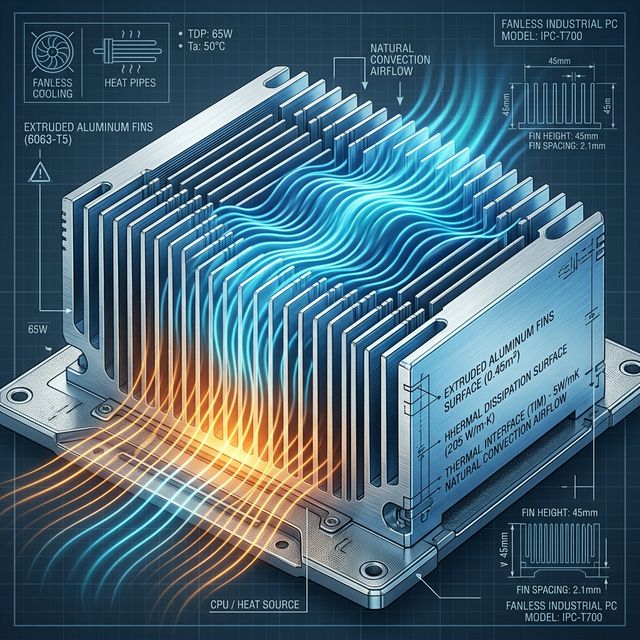
CPU heat transfers through thermal pads or copper heat pipes directly to the heavy-duty aluminum enclosure body.

🌬️

2. Convection

Precision-machined heatsink fins maximize the external surface area, drawing in cooler ambient air via natural convection.

☀️

3. Radiation

The heated aluminum enclosure continuously radiates thermal energy out into the surrounding environment.

Fanless vs Fan-Cooled: Side-by-Side

AttributeFanless IPCFan-Cooled IPC
Noise Level0 dB (silent)25–45 dB
Dust ProtectionFully sealed (IP65)Filtered intake (requires cleaning)
MTBF50,000–100,000 hours20,000–40,000 hours
MaintenanceZero (no filters or fans to replace)Fan + filter replacement every 6–12 months
Max CPU TDP15–25W (up to 35W in advanced designs)45W+ (no thermal limitation)
Vibration Tolerance5G continuous3G (fan bearings vulnerable)
Operating Temp-20°C to 60°C-10°C to 55°C (fan-dependent)
Cost (relative)10–20% premiumBaseline

Ideal Deployment Environments

01

Factory Automation

CNC workshops, welding lines, and food processing floors generate heavy dust, oil mist, and high vibration. A fanless IPC eliminates point-of-failure vulnerabilities associated with rotating fans in these harsh zones.

02

Medical & Healthcare

Imaging rooms and patient monitoring require strict 0dB noise limits and zero-particulate hygiene.

03

Transportation

In-vehicle computing and railway signaling demand continuous resistance to multi-axis shock and 5G vibration.

04

Outdoor & Remote Sites

Electrical substations, wind farms, and telecom towers experience extreme temperature swings and moisture. Fanless solutions provide zero-maintenance reliability where truck-rolls are cost-prohibitive.

Frequently Asked Questions

Expert answers to common Fanless IPC questions.

What is a fanless Industrial PC?
A fanless Industrial PC is a ruggedized computer that dissipates heat entirely through passive cooling — typically using a precision-machined aluminum alloy enclosure with integrated heatsink fins. With zero moving parts, fanless IPCs eliminate fan-related failure modes (dust clogging, bearing wear, vibration sensitivity), achieving MTBF ratings of 50,000–100,000 hours. They are ideal for dusty factories, outdoor installations, and noise-sensitive environments.
How does fanless cooling work in an Industrial PC?
Fanless cooling uses three heat transfer mechanisms: (1) Conduction — CPU and chipset heat is transferred through thermal pads or heat pipes to the aluminum enclosure; (2) Convection — the finned enclosure surface area maximizes natural air convection; (3) Radiation — the enclosure radiates thermal energy to the surrounding environment. Industrial fanless IPCs are typically designed to operate at full CPU load within a -20°C to 60°C ambient temperature range.
What are the main benefits of fanless Industrial PCs?
Key benefits include: (1) Zero maintenance — no fan filters to clean or replace; (2) Fully sealed (IP65) — prevents dust, oil mist, and moisture from entering; (3) Silent operation — 0 dB noise, essential for medical, broadcast, and retail; (4) Higher reliability — MTBF 50,000–100,000 hours vs 20,000–30,000 for fan-cooled; (5) Vibration resistant — no rotating parts to fail under 5G vibration; (6) Longer lifespan — fans are typically the first component to fail in conventional PCs.
When should I choose a fanless IPC over a fan-cooled one?
Choose fanless when: (1) The environment has dust, oil mist, or particulate pollution; (2) Noise must be below 30 dB (medical imaging rooms, broadcast studios); (3) The unit is installed inside machinery or behind panels with no maintenance access; (4) Operating in high-vibration environments (vehicles, CNC machines); (5) Remote deployment where maintenance visits are costly. Choose fan-cooled when: you need maximum CPU performance (50W+ TDP) or the ambient temperature regularly exceeds 50°C.
What is the maximum CPU TDP for fanless Industrial PCs?
Most fanless IPCs support CPUs up to 15–25W TDP (e.g., Intel Core i5-1135G7 at 15W, or Intel Core i7-1185G7E at 15W). Some advanced designs with large heatsink enclosures support up to 35W TDP processors. For workloads requiring 45W+ CPUs (e.g., Intel Core i7-12700H), fan-assisted or hybrid cooling is recommended. Yantronic's ES22 series supports up to 15W TDP processors in a fully fanless design.

Related Guides

What Is an IPC? →

Complete definition and buying guide

IPC vs Commercial PC →

12-point comparison table

Fanless Products →

Browse Yantronic's fanless IPC catalog